What Major World Religions Say about Abortion

Is abortion a religious issue? Some say yes, others say no.

At the Pennsylvania Pro-Life Federation, we believe abortion is a human rights violation that people of all faiths and no faith can work together to end.Unborn baby picture

Today, I found a helpful outline of world religions and abortion beliefs. It comes from the Society for the Protection of Unborn Children, a British organization. It helped me to understand the foundation of various religious beliefs about abortion, and I hope it will help you, too.

Here are just a few. To view the whole list, click here.

Islam teaches that life begins at conception and is created by God. The unborn child has certain rights such as the right to care, protection and life. Abortion on any grounds is forbidden in the Islamic holy book Al’Quran. “Do not kill or take a human life which God has declared to be sacred.” (Chapter 6,verse 151)

The Torah, or Jewish law, forbids the taking of innocent life and stresses that human beings are made in the image of God. Maimonides, a twelfth century interpreter of Jewish law declared: “A descendent of Noah who kills any human being, even a foetus in its mother’s womb, is to be put to death.” The only exception was if the mother’s life was in danger. However, even though traditional Judaism condemns abortion, there has been considerable argument within the Jewish community since the 1960s about whether abortion is permissible.

In Buddhism there is no central authority on ethical matters but the Dalai Lama has spoken in favour of abortion under certain circumstances. In 1993 he said: “Of course, abortion, from a Buddhist viewpoint, is an act of killing and is negative, generally speaking. But it depends on the circumstances. If the unborn child will be retarded or if the birth will create serious problems for the parent, these are cases where there can be an exception.” (Quoted by Clive Erricker in Buddhism, Hodder & Stoughton, 1995 (page 119))
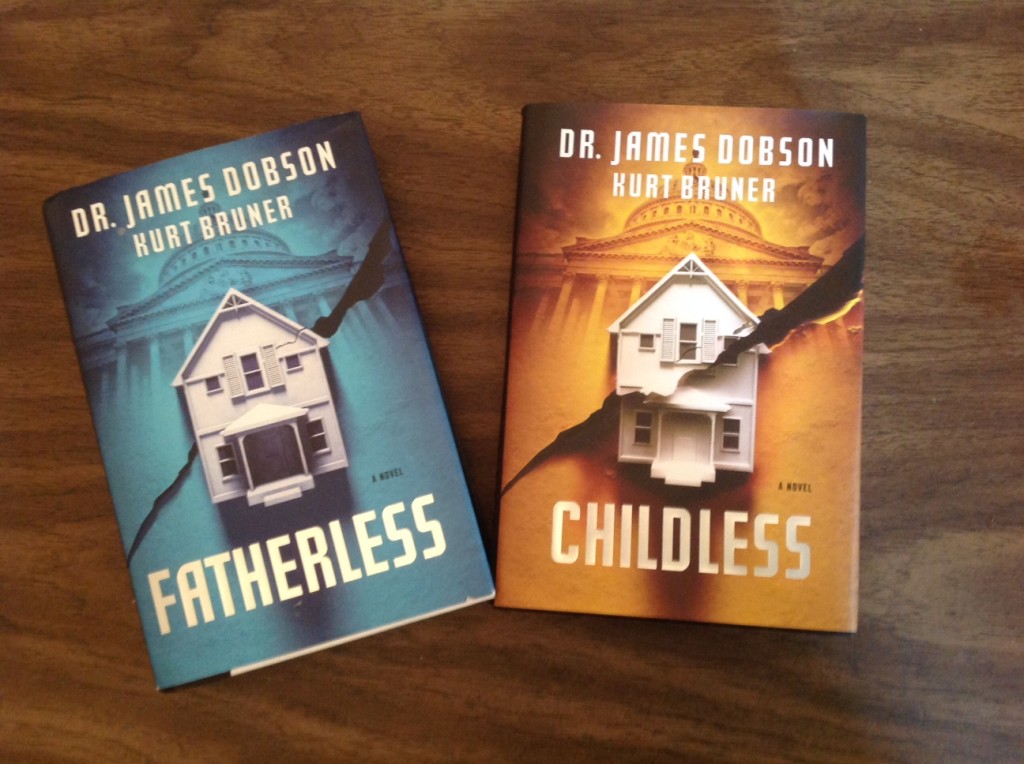
Dobson’s First Novels Take Look at Future of Abortion, Euthanasia

Last year, Focus on the Family founder Dr. James Dobson introduced his first series of novels: “Fatherless,” “Childless” and “Godless.”

photoThe novels take place several decades in the future when America is trying to recover from an economic collapse. Julia Davidson, an acclaimed journalist, is famous for her columns that celebrate the global drop in fertility and criticize marriage and motherhood. As Julia digs deeper into the modern views of life and family, she begins to uncover the consequences of the value shift.

America has become a nation where almost all babies are genetically screened and pre-selected before being implanted in the womb. “Accidental pregnancies” are aborted and the babies’ bodies sold for money. Women who have multiple children are labeled “breeders.”

The government portrays the elderly and disabled as burdens, financial drains on their families and their country. In an effort to bolster the economy, the government encourages the large elderly population to “transition” (assisted suicide).

The novels take a futuristic look at American society and individuals’ right to life — but not in a dystopian way. What I’ve enjoyed about the books so far is the way Dobson and co-author Kurt Bruner make the future world seem realistic. Most dystopian novels paint a frightening picture of a concept taken to its extreme. Dobson’s novels, on the other hand, take a more moderate approach that makes readers think, “This could actually happen.”

He gives pro-lifers a picture of what our nation could look like if it continues to denying certain people a right to life. But his novels also bring hope that, through the work of pro-lifers, we can change people’s hearts and minds and restore a culture of life in our nation.

I recently finished the first two novels in the series. “Godless,” the third and final book, was released this summer, and it’s on my reading list. Put it on yours, too.

Abortion Groups Shut Out Many Women’s Abortion Stories

Yesterday, someone shared a news article with us on our Twitter feed about a group of abortion advocates who are traveling across the U.S. to tell their abortion stories.

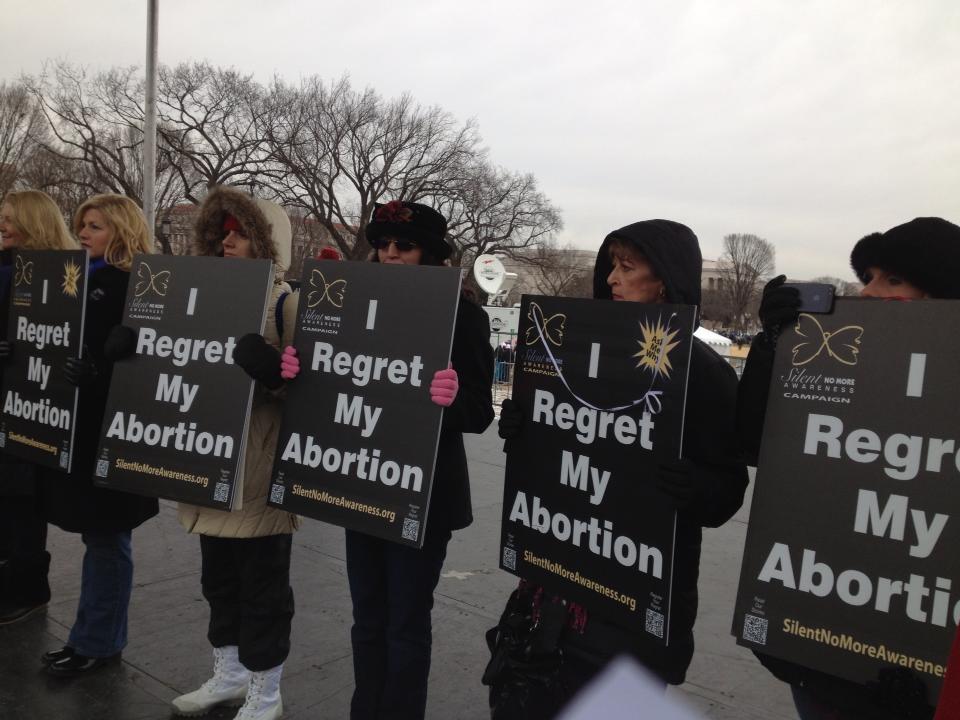
SilentNoMoreThe group Exhale wants its MoveOn tour to “change our country’s conversation about abortion” and to “help stop stigma and create a social climate where each person’s unique experience with abortion is honored and free from judgment.”

The problem is that some abortion stories are judged and ignored by these abortion groups. The thousands of stories from women who regret their abortions aren’t welcome, because they don’t fit with abortion advocates’ narrative. These groups are, in essence, silencing some women whose abortion experiences don’t fit with their agenda.

For many years, pro-life advocates have worked to free women to share their abortion stories that don’t fit the abortion agenda. The Silent No More Awareness Campaign welcomes women and men to talk about their experiences in an effort to help make the public aware of the devastation abortion brings, according to the group’s website. Since the organization began in 2002, almost 6,000 people have shared their stories.

Here is just one story from Maggie in Pennsylvania (read her full story here):

When my boyfriend cheated on me almost 30 years ago I thought it would forever remain the darkest day in my life. It didn’t compare to my Abortion that followed for this reason.

After my abortion I was disabled, the secrecy magnified my shame and became toxic to my health and spirit.

My healing came while working at a Gift Shop as a young girl entered the store contemplating having an abortion. Immediately I shared my testimony with her hoping to spare her from a lifetime of pain. She thanked me for my testimony but left undecided. About a year and a half later I heard a knock at the Gift Shop door. I began to shake because there to my surprise she stood in front of me with her beautiful 6 month bouncing baby boy as her words will forever echo in my heart. “I want to introduce my son to the woman who saved his life.”

Renewed, I vowed to do everything within my power to help prevent other women from suffering as I did, as I am “Silent No More.”

Thank you, Maggie! And thank you to all the brave women and men who are going against the grain and sharing their stories of healing after abortion.

Why Do People Turn a Blind Eye to 56 Million Aborted Babies?

A few days ago, a retired doctor visited our office. As he talked with us, he wondered out loud about an aspect of the abortion issue that I puzzle over, too.

Unborn child2The issue was this: How can people be so distraught by horrible human rights abuses such as school shootings, persecution of religious groups, or discrimination against minorities – and yet turn a blind eye to the 56 million preborn babies who’ve been aborted? How can so many Americans sit by and do nothing to end the killing of preborn babies?

I’ve been thinking a lot about these questions, too. As I was mulling the questions, a thought came to me about how abortion is almost an invisible tragedy. So few people actually see the victim, the preborn baby, or have a relationship with him or her.

My point is that we connect more with people who we relate to. We are more likely to send a meal to the family down the street whose house burned down than we are to a family in Haiti who can’t even afford one meal a day.

It’s hard to relate to a preborn baby if you’re not his/her mother or father. Sometimes it may be hard to relate even when you are the mother or father. It doesn’t mean that preborn babies are less valuable. We just have a harder time relating to them.

So, how can we help people relate to preborn babies in the womb and open their eyes to the tragedy of abortion?

One way is just to remind them that abortions are happening. I think people honestly just forget sometimes. Share an article on your Facebook page or invite them to attend a pro-life event in your area.

Another way may be to share facts and photos about preborn babies. Every time I help at a fair booth, I see people’s amazed faces as they pick up our fetal models or look at the photos of tiny babies in the womb. When people see a baby at 12 weeks sucking their thumb or twins interacting in utero, they begin to relate to preborn babies.

These are just some of my thoughts and ideas about making people more aware about abortion. I’d like to hear your thoughts, too. Please feel free to email me at lifelines@paprolife.org or comment on our Facebook page.

Where the Candidates for Governor Stand on Life

Our Legislative Director Maria Gallagher just finished a new fact sheet comparing Gov. Tom Corbett and challenger Tom Wolf on abortion and taxpayer funding of abortion.

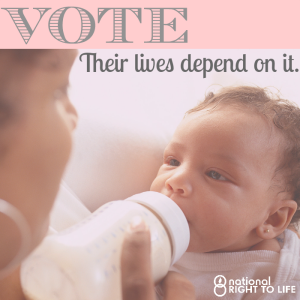
Click here find out where the candidates stand on these important issues.NRLC-Vote

Abortion rates have been dropping in Pennsylvania in the past four years, and abortion centers have been closing their doors. But there is still a lot of work to do.

Every 15 minutes, a baby dies in an abortion in Pennsylvania. Every 15 minutes, we are losing another precious human life in our state. Every 15 minutes, a woman is being subjected to an abortion, a tragedy that may stay with her for the rest of her life.

Babies and their moms deserve better than abortion. Pennsylvania needs leaders who are dedicated to supporting and protecting both baby and mom from this far too common tragedy.

Election Day is Tuesday, November 4 in Pennsylvania. If you aren’t registered to vote, you still have time to. Click here for details.

Former Abortion Counselor Says Her Problem Was Misplaced Compassion for Women

Have you ever wondered, “Why, oh, why would someone ever work at an abortion center?”

Linda Couri, a former Planned Parenthood counselor, answers, “Good intentions.”

But, Couri says, “The road to Hell is paved with good intentions.”Mom-and-Child

I listened to Couri’s story a few days ago through LifeNews.com, and her honesty and candor impressed me. Her story is about an hour long, but it’s well worth watching here.

She talked about something I’ve long suspected about many of the people who work at abortion centers like Planned Parenthood. They have good intentions. They truly want to help women. But their compassion is misplaced (all for the woman, none for the baby).

Couri said she took a pay cut to work at Planned Parenthood, because she truly wanted to help women in difficult circumstances. When she met with women who were unexpectedly pregnant, afraid and unprepared for motherhood, she counseled them to abort. She thought it was the best option.

Only after a series of events did Couri realize the terrible mistake in her reasoning and its consequences. One day, a teenager asked if she was killing her child. Couri struggled to answer, but the question haunted her. Later, she began reading journal entries written by women as they were recovering from their abortions. Couri was shocked to find how distraught many of the women were.

And she wondered if abortion really helps women. She wondered how she could continue to justify killing preborn babies. When she realized the truth, she quit her job. Now she is a pro-life speaker.

I think it’s important that we really listen to pro-lifers like Couri because she helps us to understand why many abortion center workers and abortion advocates do what they do. If we work to listen and understand them, we can help encourage them to extend their compassion to both mother and child.

The Overpopulation Debate and Solutions to the World’s Problems

The other day I listened to a debate about overpopulation with Steven Mosher from the pro-life Population Research Institute and Robert Walker of the pro-abortion Population Institute.

GlobeWomanYou can watch it here. It’s about an hour long, but it’s worth listening to if you have time. Steven Mosher is a very knowledgeable and persuasive debater.

When I used to hear the word “overpopulation,” it always made me think of disappearing rainforests, endangered species, global warming, and poverty. Since I began working in pro-life, though, I’ve realized the scary implications of the overpopulation theory.

How do we stop overpopulation? We get rid of people (abortion, euthanasia). And how do we make it seem ok to get rid of people? By making some people appear less valuable than others (the preborn, the elderly and the disabled).

The heart of the issue really seems to come back to the value of human life. I’m not saying those other issues aren’t important. We need to take care of our planet and the plants and animals that live here.

But, as Steven Mosher argues, people have found innovative ways to solve these challenges, and will continue to do so – without killing other people.

Mosher summed it up very well in his response to Walker: “You see the problem as people. I see the problem as poverty.”

Abortion and euthanasia are the same way. There are better solutions to the world’s problems than killing innocent people. Our world doesn’t need more abortions, more euthanasia, or fewer people. Our world needs more people who will listen, care and treat others with the respect they deserve.

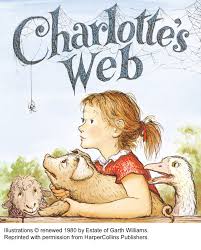
A Lesson from “Charlotte’s Web”

A few Sundays ago, when I was visiting my family, my little sister pulled out a paperback copy of “Charlotte’s Web” and asked if I would read to her.

CharlottesWebI hadn’t read the book in years – maybe not even since I was 8, the same age as my little sister. We sat down on the sofa, and I turned the pages to Chapter 1:

“Where’s Papa going with that ax?” said Fern to her mother as they were setting the table for breakfast.
“Out to the hoghouse,” replied Mrs. Arable. “Some pigs were born last night.”
“I don’t see why he needs an ax,” continued Fern, who was only eight.
“Well,” said her mother, “one of the pigs is a runt. It’s very small and weak, and it will never amount to anything. So your father has decided to do away with it.”
… Fern pushed a chair out of the way and ran outdoors. …
“Fern,” said Mr. Arable, “I know more about raising a litter of pigs than you do. A weakling makes trouble. Now run along!”
“But it’s unfair,” cried Fern. “The pig couldn’t help being born small, could it? If I had been very small at birth, would you have killed me?”
Mr. Arable smiled. “Certainly not,” he said, looking down at his daughter with love. “But this is different. A little girl is one thing, a little runty pig is another.”
“I see no difference,” replied Fern … “This is the most terrible case of injustice I ever heard of.”
A queer look came over John Arable’s face. He seemed almost ready to cry himself.
“All right,” he said.

Fern’s words almost seem prophetic, “If I had been very small at birth, would you have killed me?” Today babies in the womb are killed just because they may have a disability or abnormality. Many parents are pressured toward abortion because their baby is imperfect in the world’s eyes. Our society justifies these babies’ deaths with excuses: The baby may suffer, or the baby could be a burden for the family, or the baby may not live long anyway. I think the problem lies with our flawed perspective, not these children’s lives.

I was really struck by Fern’s example. She fought and pleaded for a life who many didn’t see as valuable. She gave up her time to provide the extra care and attention that that life needed.

Fern approached the situation from the simple, untainted logic of a child. She didn’t think twice. She didn’t question whether a life was worth saving, because it never occurred to her to question the value of a life at all. She understood that every life deserves protection, no matter how long they live or how much care they need.

I’m so glad “Charlotte’s Web” is still a classic on children’s bookshelves. We need more heroines like Fern.

Images of Preborn Babies Open People’s Eyes to Truth about Life

I love seeing people’s faces light up when a preborn baby’s life becomes real to them.

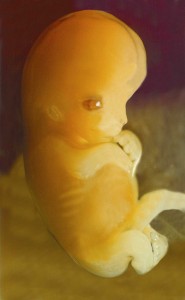
Image of a baby at seven weeks

Image of a baby at seven weeks

It’s hard for us to relate to people we don’t know, people we’ve never seen or talked to. And most of us don’t see a baby until after he or she is born. It can be easy for us to forget about the ongoing tragedy of abortion, because we almost never know the victim.

That’s why we at the Federation emphasize education about human development. We show ultrasound videos and share little fetal models with people. They remind people that this isn’t just a “product of conception” or a “blob of tissue.” It’s a teeny, tiny beautiful human being – somebody’s baby boy or baby girl.

Click here to read more about a baby’s amazing development in the womb. Or watch a video here.

Pennsylvania Girl Gives Hope to Down Syndrome Families with “Chloe’s Law”

We have a young heroine for life in our state.

Her name is Chloe Kondrich, and she has Down syndrome. The 11-year-old and her family have made it their mission to educate people about the precious value of individuals with Down syndrome. The family received our Pennsylvania Pro-Life Leadership Award in 2011.

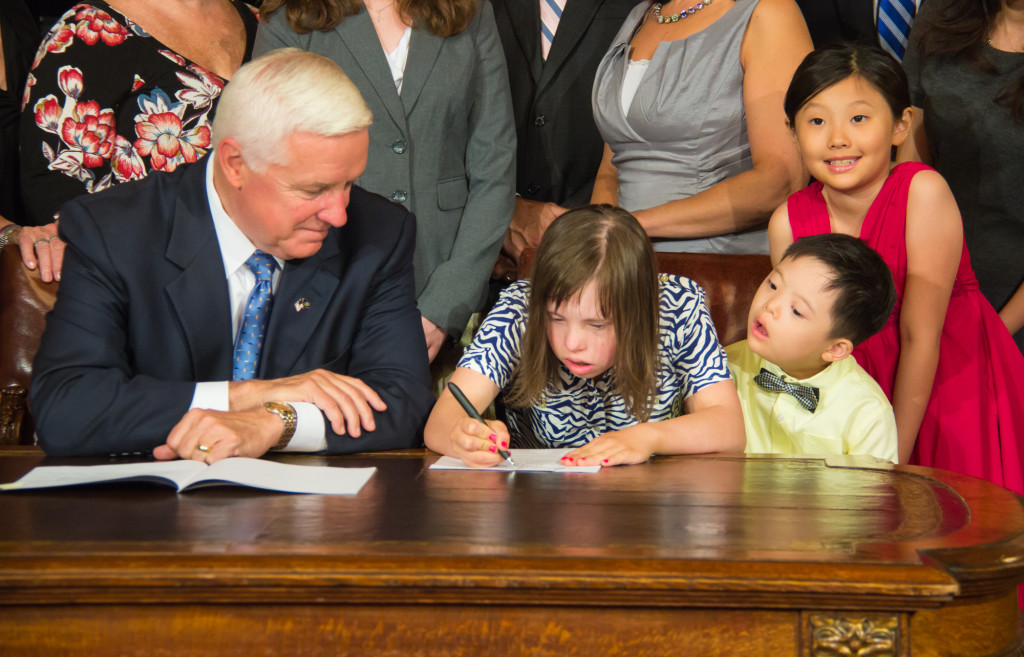
Chloe Kondrich joins Gov. Tom Corbett to sign "Chloe's Law" on July 18, 2014, in Harrisburg.

Chloe Kondrich joins Gov. Tom Corbett to sign “Chloe’s Law” on July 18, 2014, in Harrisburg.

On Friday, July 18, Chloe stood with Gov. Tom Corbett as he signed “Chloe’s Law,” a measure that ensures Pennsylvania moms have access to accurate information and support when their preborn baby is diagnosed with Down syndrome.

Sadly, preborn babies who are diagnosed with Down syndrome often become victims of abortion. One study suggests that 90 percent are aborted.

According to an article in the Pittsburgh Post-Gazette:

“Kishore Vellody, medical director of the Down Syndrome Center at Children’s Hospital of Pittsburgh of UPMC … [said] he sees the necessity of the new law, which will outline physicians’ responsibilities in delivering the news of a Down syndrome prenatal diagnosis.

“‘Published data shows that less than half of people felt like their training was accurate in communicating prenatal diagnosis,’ he said. ‘Even in my med school textbooks, a lot of things we learned about Down syndrome was inaccurate because it takes so long to have them updated.’

“Within the past 30 years, the increase in information and standard medical care has been dramatic and is mirrored by the increase in life expectancy for people with Down syndrome, from 25 in the 1980s to 60 and beyond now.

“‘Our goal in medicine is to make sure people receive balanced and accurate information when they make decisions about health care,’ Dr. Vellody said. ‘That’s why we support endeavors to help expectant parents.'”

Chloe’s parents, Kurt and Margie Kondrich, understand the emotions that families feel when they discover their child has Down syndrome. They believe the new law will help alleviate fears and give hope to the families.

Chloe and her family truly are Pennsylvania heroes, spreading the message to families that there’s always a reason to choose life!