Assisted Suicide, Quick Fixes, and a Lesson from My Dad

Growing up, my dad always impressed upon us the importance of doing a job well.

He didn’t believe in quick fixes. When we worked with him, we were expected to finish the job right. If we made a mistake, he helped us repeat the task until it was correct.
OldwomanPerhaps the biggest test of this work ethic came when my father took on the huge task of building a home for us. I remember when my siblings and I helped him measure and lay the cinder block foundation. I was about 14 at the time, and I remember thinking he was being very fussy about measurements. He told us, if the foundation was even a fraction of an inch off, it would cause major problems as we built the rest of the house.

Throughout the building process, he strongly emphasized that we must not take short cuts or try to quick-fix a mistake we had made. He promised that he wouldn’t be angry if we made a mistake, but he would be upset if we tried to cover it up. And he was true to his word. If we made a mistake, he was patient with us. He took the time to teach us how to do it correctly, though it created more work for him.

Now as I look back, I realize how vitally important that lesson is to my work today. A recent episode of 60 Minutes reminded me of the newest quick fix being proposed in our society – legalized assisted suicide.

The show focused on the case of Barbara Mancini, a Schuylkill County woman who was arrested after allegedly helping her 93-year-old father, Joseph Yourshaw, commit suicide. Mancini later was exonerated due to the lack of evidence.

Still, Mancini told 60 Minutes that her father should have had the option to commit assisted suicide. She said her father was in pain, and he told people he wanted to die. Mancini now is working with the pro-euthanasia group Compassion and Choices to push for legalized assisted suicide.

But Dr. Ira Byock, who was interviewed later in the show, exposed assisted suicide as a quick-fix solution that ignores the real issue.

Byock, a Dartmouth College professor and a medical expert in end of life care, reviewed Yourshaw’s medical and hospice records and discovered that he was not receiving adequate care for his pain. Byock explained that almost all pain can be managed with modern medicine, but many health care providers aren’t trained well in pain management.

He also pointed out that the elderly and terminally ill are often made to feel that they are burdens on society, and Yourshaw felt he was being a burden, according to his medical records.

Byock emphasized that the solution for people like Yourshaw is not assisted suicide but better end-of-life care and the assurance that their lives still matter.

But making that solution a reality takes a lot of hard work. Our job as pro-lifers isn’t easy, just as my dad’s job wasn’t easy. It takes patience and perseverance to help an elderly or ill person through their day to day life. It takes hard work and dedication for health care professionals to learn the additional skills necessary to help relieve patients’ pain.

But without hard work, what do we get? The quick fixes of assisted suicide and abortion. They take away something valuable that we can never get back, no matter how hard we work — an individual person’s life.

Generation Y and Why They Are Naturally Pro-Life

By Maria Gallagher, Legislative Director
gallagher@paprolife.org

“You’ve got to be taughtClassroom
To hate and fear,
You’ve got to be taught
From year to year,
It’s got to be drummed
In your dear little ear
You’ve got to be carefully taught.”

— From the Broadway musical “South Pacific”

The lyrics above explored discrimination — but I think the sentiment also applies to the pro-abortion cause. I think you have to be carefully taught to deny the humanity of the unborn child and to accept Roe v. Wade.

I was reminded of this truism during a recent talk I gave to 7th and 8th grade religion students. I started by asking them how many abortions they thought took place in the U.S. each year. When I told them the number was estimated at more than a million, a look of incredulity crossed their faces — as if I had informed them their parents were throwing out their cell phones.

When we ventured onto the topic of euthanasia, their bewilderment increased. They could not understand why anyone would intentionally kill anyone — especially an elderly person or a person with a disability — under the guise of compassion. They were astounded.

I suppose someone on the pro-abortion side might argue that these students lacked the maturity to fully understand the issue of abortion. Yet, the same individual would probably argue that the female students would be mature enough to go before a judge and obtain a judicial bypass for an abortion.

Which is it — are young people not thoughtful enough to grasp Roe? Or are they so mature that they no longer need parental input in their decisions?

I would argue that a young person’s tendency is to treasure life — especially the lives of people younger than themselves. It is only when society brainwashes them into believing that life is random, dependent upon another’s whims, and disposable that they veer off into pro-abortion land.

After all, you have to be carefully taught.

Abortion Advocates, What Are You Doing to Protect Women from Other Gosnells?

It’s time that we ask abortion advocates what they are doing to protect women from abortionists like Kermit Gosnell.

gosnell40These groups claim to advocate for women’s health. Yet they have not taken action to protect women after witnessing perhaps the most horrific treatment of women and babies at an abortion practice in modern history.

Abortion advocates joined pro-lifers in condemning Gosnell’s horrible practice. They were horrified by the case. But that’s where their actions stopped.

It’s clear that these groups do not believe abortion center regulations will meet their goals. Abortion advocates are vehemently opposed to laws such as those passed in Pennsylvania and Texas in response to Kermit Gosnell and the women and babies who he hurt and killed.

It’s time that we call them out and ask: what are they doing to protect women from abortionists who abuse and misuse their patients? And what do they believe our nation should do? If not abortion center regulations, what?

Some may say: “Gosnell certainly was terrible, and he deserves to be in prison. But he was just an outlier, an anomaly.”

The Kermit Gosnell case certainly was unlike anything America had ever witnessed before. Gosnell maimed and murdered women and babies for decades before authorities discovered him.

But there is evidence that Gosnell isn’t the only abortionist who is abusing women and babies. Consider Steven Brigham, Douglas Karpen, James Pendegraft, Charles Rossman. I could go on.

How are we to know whether there aren’t other abortionists like them? Gosnell got away with murder for decades due to the lack of abortion center regulations. The grand jury in Gosnell’s case recommended abortion center regulation laws so that other Gosnells wouldn’t be able to practice undetected.

Others may say: “We should do something, but abortion center regulations are doing more harm than good. These new laws are just shutting down women’s access to abortion. These laws will drive women to the back alley.”

But without abortion center regulations, couldn’t back alley abortionists be practicing on main street? Kermit Gosnell was.

Also, these laws are not stopping abortion advocates from opening new centers or upgrading their current ones to meet the basic health and safety standards required by the new laws. Sure, it takes time and money to build or upgrade anything, but isn’t the money worth it to ensure women’s health and safety?

Still others may say: “Abortion center regulations are just thinly veiled attempts to shut down abortion centers. Anti-abortionists want to take away a woman’s right to abortion.”

Unfortunately, the mainstream media has perpetuated the lie that pro-lifers could care less about women. We only care about babies.

The truth is that pro-lifers are stepping up where abortion advocates are not. We are fighting to protect women from abortionists like Gosnell. We work to pass abortion center regulations because women deserve better.

Abortion advocates have failed to protect women from abusive abortionists like Gosnell. It’s time we call them out and ask them: If you care about women, as you say you do, what are you doing to protect women from other Gosnells?

Doula Struggles with Saying 11-Year-Old’s Abortion, Sex-Selection Abortion Are Wrong

I read a lot of terrible abortion stories for my job, but some break my heart more than others.

Mom-and-ChildA few weeks ago, I came across a column in the New York Magazine written by an abortion doula. Curious, I clicked on the story and read about the young woman, who provides emotional support for women as they have abortions.

I began to feel more and more horrified as I read about her work and her attempts to justify really terrible things. She writes:

“A year ago, when I was just starting out, Mitchell met with me and the other trainees to talk about the job. We sat in the park, eating pie. She gave us a sheet with situations so exaggeratedly horrible they seemed unreal: An 11-year-old in for an abortion who asks for birth control when she’s alone with the doctor. Her mother works nights; she’d been left with a friend who has a twentysomething son. She calls him her boyfriend; he will go to jail. A woman who says she’d like to do another ultrasound to see if it’s definitely a girl, because she’ll only keep it if it isn’t. …
“’What do you assume?’ Mitchell asked of each case. ‘How can you be supportive?’ We talked about what would be hard for us to overcome, things we might say or do and how we might feel. I felt embarrassed by my assumptions, and the limits of my compassion. I judged these women on the worthiness of their reasons (‘Would she really only keep a boy?’ I wondered) and found myself questioning why those who come in for late-term abortions had waited so long to decide. Later, I learned from Mahoney that all the examples were real cases that had come from her first six months working as an abortion doula.” (You can read the full article here. Parts of it are graphic.)

I hung my head in anger and shame as I read about this young woman from my own generation, a young woman so caught up in the net of moral relativism that she believes it is compassionate to dismiss the rape of an 11-year-old or condone the woman who is aborting her baby simply because she’s a girl.

My generation place high moral value on the idea of acceptance and non-judgment. I think it comes from college, where we’ve been taught moral relativism – your morals aren’t better than mine, and mine aren’t better than yours. We have no right to judge someone else’s actions or beliefs. There is no right or wrong.

Acceptance, inclusiveness, a judgment-free attitude – these are all good things. But when these concepts are taken to the extreme of moral relativism, they become dangerous, and this article is a perfect example of it. Acceptance and non-judgment are no excuse for ignoring things that are truly terrible.

Sometimes people are wrong. Rape is wrong. Taking advantage of a child is wrong. Sex trafficking is wrong. Ignoring the victim of a crime is wrong. Killing an innocent person is wrong.

I could feel the columnist struggling with right and wrong throughout her column. Some situations seemed wrong to her, and rightly so. Yet, moral relativism won the hour.

Let’s not let it win the day. Abortion is wrong. We must never shy away from saying it – though we also must be compassionate when we do. Contrary to what moral relativists would have us believe, realizing that something is wrong opens the doors for us to extend a hand of compassion and love to those who are hurting. And that is true compassion.

How One Student’s Pro-Life Speech Impacted Millions for Life

In 2009, 12-year-old Lia Mills wowed the pro-life community with a simple YouTube video of her school speech about abortion.

Lia spoke so articulately and passionate about protecting life that her video immediately spread across the globe. Watch it here. LiaMills1

“What if I told you that, right now, someone was choosing if you were going to live or die?” she says in the video. “Thousands of children are right now in that very situation. That someone is their mother. And that choice is abortion.”

Today, her video has more than 2.4 million views on YouTube, but her impact has been so much more than mere numbers.

According to a 2012 article in Toronto Life, Lia has received many “thank you” notes from pregnant women who watched her video and decided not to have an abortion. She also travels throughout the U.S. and Canada speaking and inspiring thousands of pro-lifers.

Lia’s exceptional story is an example of why our organization hosts an annual Pro-Life Oratory Contest for students. We believe in encouraging young people to use their voice for life. When young people speak up with passion and sincerity, people listen, and babies and their moms are spared from the pain of abortion.

Our contest is open to students in 9th to 12th grades. Students must write their own original speeches on the topic of abortion, euthanasia, or stem cell research, videotape the speech, and submit it to us by April 15, 2015. For details, email lifelines@paprolife.org or click here.

Please encourage students you know to participate. Like Lia, they can make a big impact for life!

What Major World Religions Say about Abortion

Is abortion a religious issue? Some say yes, others say no.

At the Pennsylvania Pro-Life Federation, we believe abortion is a human rights violation that people of all faiths and no faith can work together to end.Unborn baby picture

Today, I found a helpful outline of world religions and abortion beliefs. It comes from the Society for the Protection of Unborn Children, a British organization. It helped me to understand the foundation of various religious beliefs about abortion, and I hope it will help you, too.

Here are just a few. To view the whole list, click here.

Islam teaches that life begins at conception and is created by God. The unborn child has certain rights such as the right to care, protection and life. Abortion on any grounds is forbidden in the Islamic holy book Al’Quran. “Do not kill or take a human life which God has declared to be sacred.” (Chapter 6,verse 151)

The Torah, or Jewish law, forbids the taking of innocent life and stresses that human beings are made in the image of God. Maimonides, a twelfth century interpreter of Jewish law declared: “A descendent of Noah who kills any human being, even a foetus in its mother’s womb, is to be put to death.” The only exception was if the mother’s life was in danger. However, even though traditional Judaism condemns abortion, there has been considerable argument within the Jewish community since the 1960s about whether abortion is permissible.

In Buddhism there is no central authority on ethical matters but the Dalai Lama has spoken in favour of abortion under certain circumstances. In 1993 he said: “Of course, abortion, from a Buddhist viewpoint, is an act of killing and is negative, generally speaking. But it depends on the circumstances. If the unborn child will be retarded or if the birth will create serious problems for the parent, these are cases where there can be an exception.” (Quoted by Clive Erricker in Buddhism, Hodder & Stoughton, 1995 (page 119))

Bishop Gainer: Pro-Life Is a ‘Hello?!” Movement

Did you read about the man who escaped from jail 89 days into a 90 day sentence? Or about the thief who walked into a store, took the cash, and then let the clerk borrow his cell phone to make a call – to the police?

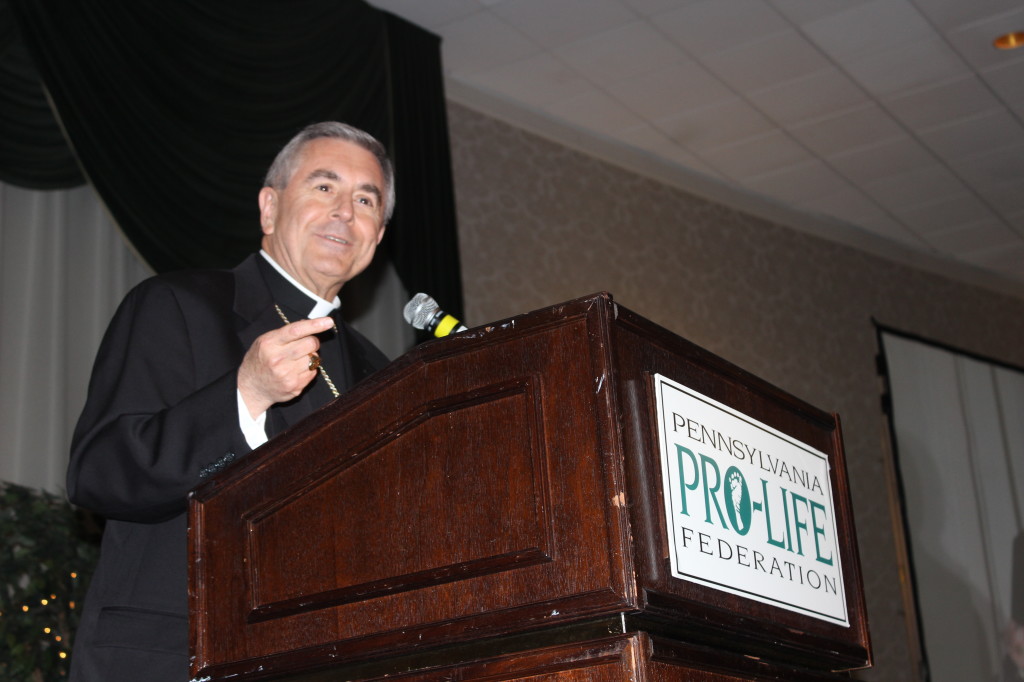
Bishop Ronald Gainer at the 2015 Celebrate Life Banquet in Harrisburg

Bishop Ronald Gainer at the 2015 Celebrate Life Banquet in Harrisburg

“Hello?!”

“(It’s) a word we say to someone who just doesn’t seem to get it,” the Most Rev. Ronald Gainer told a crowd of 600 pro-lifers gathered in Harrisburg for our 2014 Celebrate Life Banquet.Gainer, the new bishop of the Roman Catholic Diocese of Harrisburg, compared the pro-life movement to the term “hello?!” because we are “calling out to a culture that has drifted from the truth.”He challenged pro-lifers to think about three issues in our modern culture that keep people from understanding the tragedies of abortion, euthanasia and embryonic stem cell research.

First, our inability to use right reasoning.

Our culture quickly and easily falls for marketing messages, Gainer said. Pro-abortion advocates appeal to people with deceptive marketing that evokes desire and emotion.

Gainer called on pro-lifers to help our culture see past the pro-abortion side’s deceptive marketing appeals by using logic and reasoning to defend innocent human beings.

He used the example of fetal homicide laws, which are in place in most states to protect preborn babies from being victims of violence. Every law has an exception carved out for abortion, though.

“Hello?!” Gainer echoed.

Second, our inability to remember.

Gainer also called on pro-lifers to remind our culture of the history that we too often forget. It’s important that we look to the past so that we can learn from history and heed its warning signs.

He asked pro-lifers to consider the culture in Germany several years before the Holocaust. The ethical framework allowing human rights abuses started in the country’s medical and academic institutions years before the Holocaust took place, he said.

Third, our inability to understand freedom.

Many believe that freedom simply exists to do whatever we want, but choice for its own sake is not freedom, Gainer said.

“Authentic freedom lies in the ability to recognize what is true and the courage to do what is right,” he said.

Gainer ended by encouraging pro-lifers to march on with joy and boldness as we continue our work to educate our culture about the value of every single human life.

To watch or read Gainer’s full speech, click here.

Big Crowd Gathers for Inspiring Pro-Life Evening in Harrisburg

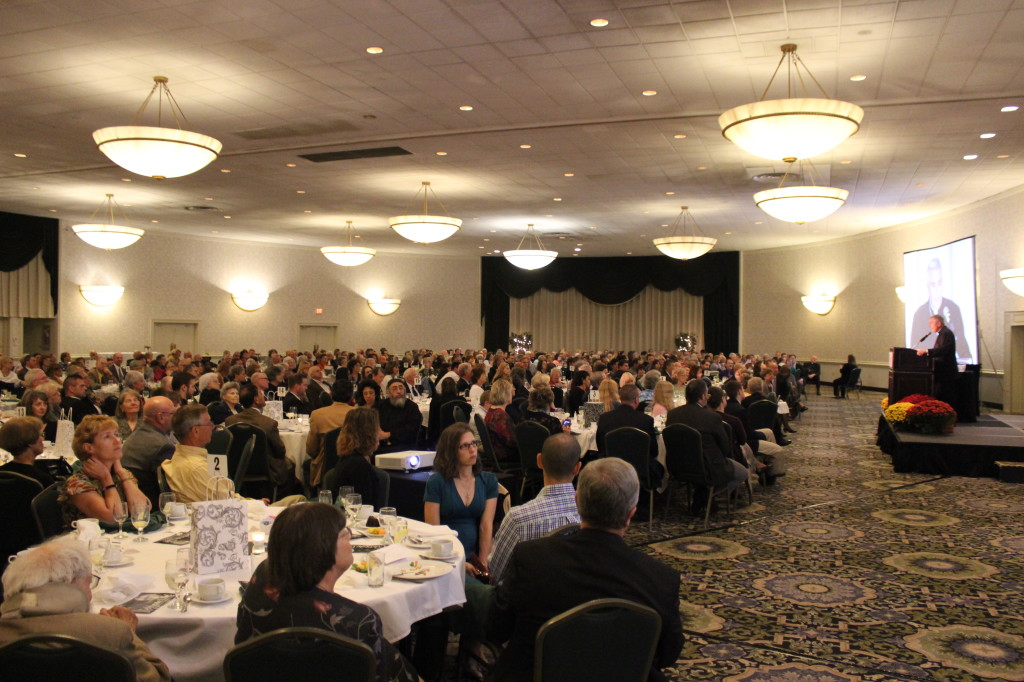
Today is one of those rare days when I’m feeling exhausted and energized, inspired and tired. Last night was our 2014 Celebrate Life Banquet in Harrisburg, which drew 600 people from all across the state. IMG_1652

The evening was truly inspiring, and I’m not just saying that. I felt so encouraged to see pro-lifers from all across the state and all walks of life who gathered together in unity for our great cause – to protect and defend every human life from conception to natural death.

It takes a lot of work here in our office to put together our annual banquet. And though I’m still physically tired from the event, I’m also feeling energized by the enthusiasm and dedication of so many fellow pro-lifers.

Read local news coverage of the banquet here. And check back in later to read about our keynote speaker the Most Rev. Ronald Gainer, bishop of the Roman Catholic Diocese of Harrisburg, and his challenge to pro-lifers about how we can change our culture for life.

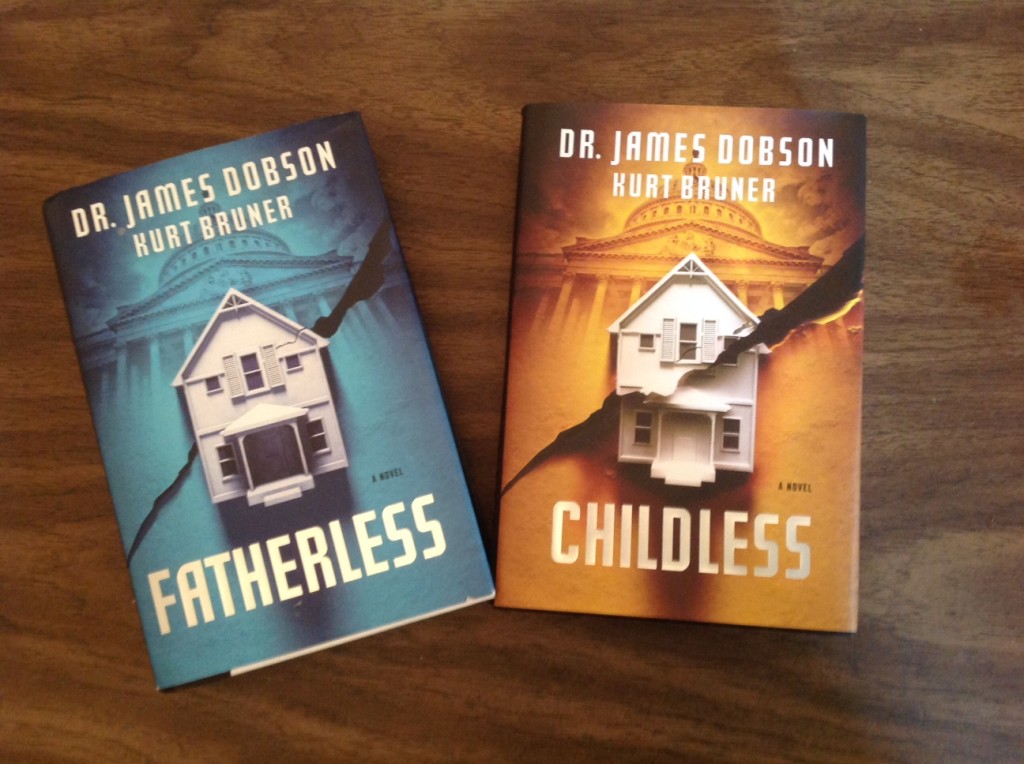
Dobson’s First Novels Take Look at Future of Abortion, Euthanasia

Last year, Focus on the Family founder Dr. James Dobson introduced his first series of novels: “Fatherless,” “Childless” and “Godless.”

photoThe novels take place several decades in the future when America is trying to recover from an economic collapse. Julia Davidson, an acclaimed journalist, is famous for her columns that celebrate the global drop in fertility and criticize marriage and motherhood. As Julia digs deeper into the modern views of life and family, she begins to uncover the consequences of the value shift.

America has become a nation where almost all babies are genetically screened and pre-selected before being implanted in the womb. “Accidental pregnancies” are aborted and the babies’ bodies sold for money. Women who have multiple children are labeled “breeders.”

The government portrays the elderly and disabled as burdens, financial drains on their families and their country. In an effort to bolster the economy, the government encourages the large elderly population to “transition” (assisted suicide).

The novels take a futuristic look at American society and individuals’ right to life — but not in a dystopian way. What I’ve enjoyed about the books so far is the way Dobson and co-author Kurt Bruner make the future world seem realistic. Most dystopian novels paint a frightening picture of a concept taken to its extreme. Dobson’s novels, on the other hand, take a more moderate approach that makes readers think, “This could actually happen.”

He gives pro-lifers a picture of what our nation could look like if it continues to denying certain people a right to life. But his novels also bring hope that, through the work of pro-lifers, we can change people’s hearts and minds and restore a culture of life in our nation.

I recently finished the first two novels in the series. “Godless,” the third and final book, was released this summer, and it’s on my reading list. Put it on yours, too.

Abortion Groups Shut Out Many Women’s Abortion Stories

Yesterday, someone shared a news article with us on our Twitter feed about a group of abortion advocates who are traveling across the U.S. to tell their abortion stories.

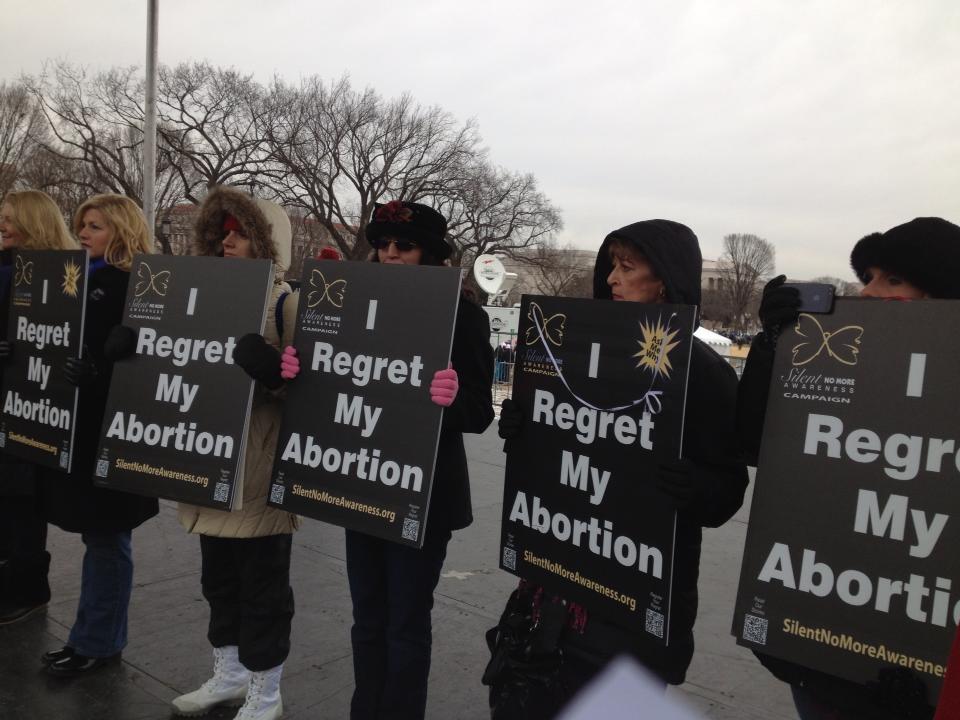
SilentNoMoreThe group Exhale wants its MoveOn tour to “change our country’s conversation about abortion” and to “help stop stigma and create a social climate where each person’s unique experience with abortion is honored and free from judgment.”

The problem is that some abortion stories are judged and ignored by these abortion groups. The thousands of stories from women who regret their abortions aren’t welcome, because they don’t fit with abortion advocates’ narrative. These groups are, in essence, silencing some women whose abortion experiences don’t fit with their agenda.

For many years, pro-life advocates have worked to free women to share their abortion stories that don’t fit the abortion agenda. The Silent No More Awareness Campaign welcomes women and men to talk about their experiences in an effort to help make the public aware of the devastation abortion brings, according to the group’s website. Since the organization began in 2002, almost 6,000 people have shared their stories.

Here is just one story from Maggie in Pennsylvania (read her full story here):

When my boyfriend cheated on me almost 30 years ago I thought it would forever remain the darkest day in my life. It didn’t compare to my Abortion that followed for this reason.

After my abortion I was disabled, the secrecy magnified my shame and became toxic to my health and spirit.

My healing came while working at a Gift Shop as a young girl entered the store contemplating having an abortion. Immediately I shared my testimony with her hoping to spare her from a lifetime of pain. She thanked me for my testimony but left undecided. About a year and a half later I heard a knock at the Gift Shop door. I began to shake because there to my surprise she stood in front of me with her beautiful 6 month bouncing baby boy as her words will forever echo in my heart. “I want to introduce my son to the woman who saved his life.”

Renewed, I vowed to do everything within my power to help prevent other women from suffering as I did, as I am “Silent No More.”

Thank you, Maggie! And thank you to all the brave women and men who are going against the grain and sharing their stories of healing after abortion.