So Much More than a Statistic

By Bonnie Finnerty, Education Director

Somewhere in Pennsylvania in 2019, an abortion was performed on a 12-year-old girl.

We don’t know her name.  Or her story.

We do know she was not the only one. The 2020 PA Department of Health annual report on abortion reveals that three other 12-year-old girls also had abortions. And twelve 13-year-olds. Fifty-five 14-year-olds.  One hundred sixteen 15-year-olds. All in our Commonwealth, all in one year.

We know nothing of the circumstances surrounding their pregnancies, but we do know that each of these precious young women, many still in middle school, have endured something they shouldn’t have.

They- and their unborn children-are more than a statistic.

Compounding the tragedy of ending an innocent life in the sanctuary of the womb is the additional horror that abortion fails to protect vulnerable young girls from trauma.  They too are victims and deserving of our help and protection.  

What steps did the abortion business take to make sure these young women were not being returned to a situation marked by unhealthy relationships, abuse, molestation, or sex trafficking?  What help did they offer to assure they are not repeat customers?

Or was the abortion simply a financial transaction, where problematic “evidence” is “erased” for a dollar amount while the root problem itself remains unaddressed?  Is not abortion then the abuser’s tool, allowing for continued exploitation of young women?

Abortion ends the life of a human already created, but it does not end the situation that may have given rise to that life. And so the cycle continues.

While many who support abortion claim it liberates women, the fact is abortion can enslave women to toxic relationships and perpetuate abuse. Coercion, whether strong or subtle, characterizes almost 2/3 of abortions as reported by the women who get them.

And yet, the abortion business seems to have no desire to protect vulnerable women or reduce abortion, even among teens. In fact, former abortion workers report that the industry actually aspires to have women come back for multiple abortions. Some centers actually set abortion quotas for a given year knowing it is their most profitable “service.”

It’s a most sinister business model, but, sadly, one that seems to work for the abortion industry. In 2019, 47.3% of abortions performed in Pennsylvania were repeat abortions. Of those, 4.6% (1,437) were to women having had four or more previous abortions and 5.5% (1726) to women having had three previous abortions.

These women-and girls- are so much more than a statistic or business transaction.

They deserve better from a society that claims to be “woke” and to fight for marginalized populations. We afford more legal protection to animals than to these precious human beings.

These women deserve to be helped out of difficult situations and protected from harm. They deserve to be supported, encouraged, and empowered. And their innocent children, no matter the circumstances of their conception, deserve a chance at life, not the death penalty.

Behind each statistic is a true-life story with real people in need. The pro-life movement is working hard to rewrite a better, brighter, and life-affirming next chapter for all of them.   

The Propaganda that drove Roe

By Bonnie Finnerty, Education Director

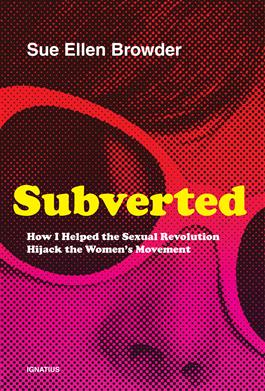
The fourth installment in our weekly blog on Subverted: How I Helped the Sexual Revolution to Highjack the Women’s Movement by Sue Ellen Browder.

The longing for truth is etched on the human heart, leading us to search in all kinds of places for it. Yet, often, we are left dissatisfied.

Such was the case with two very different people, a man and a woman, in the early 1970’s: a struggling freelance writer and an accomplished Supreme Court Justice.

Unknown to one another, they were both exploring the same questions regarding women and equality.  

Sue Ellen Browder admits in her memoir Subverted: How I Helped the Sexual Revolution to Highjack the Women’s Movement that she sought answers in Abraham Maslow’s humanistic psychology of “self-as-God” and in Germaine Greer’s “fearlessness” as the path to true freedom. Consequently, with disregard to her own moral compass, she threw herself into her career, certain it was there she would find true self-fulfillment.

Around the same time, Justice Harry Blackmun, a Republican, Methodist, and family man, struggled for months to write the majority opinion for Roe vs. Wade. His first draft was roundly rejected by liberal colleagues who considered it too weak an argument for abortion. Blackmun vowed to come up with a stronger legal opinion.

His 28 year-old law clerk, known for his excellent writing skills, would come to his rescue. He possessed a book that could be used to bolster the case. Abortion: The first authoritative and documented report on the laws and practices governing abortion in the U.S. and around the world, and how-for the sake of women everywhere-they can and must be reformed was written by National Association for the Repeal of Abortion Laws co-founder Larry Lader.  

This particular book had convinced National Organization for Women president Betty Friedan to insert an abortion platform into the women’s movement. It would be footnoted in Blackmun’s majority opinion no less than seven times. The problem, however, was that it was far more propaganda than fact.

Browder writes, “For when Blackmun accepted Larry Lader, a mere magazine writer, as a reliable authority on history, philosophy, and theology, he became a blind man following a blind guide.”

A newly crafted opinion was finalized on August 10, 1972 and in a highly unusual move, Blackmun’s law clerk circulated it to the other justices before final oral arguments without being first fact-checked. He believed that among other things, this step “might well influence voting.”

The strategy worked in that six other justices joined Blackmun in the final vote on Roe. However, the opinion itself was widely criticized in the legal world.  One law professor and well-known abortion supporter, John Hart Ely, called the opinion “bad,” saying “it is not constitutional law and gives almost no sense of an obligation to try to be.”

Blackmun was accused by pro-abortion historian David Garrow of ceding “far too much of his judicial authority to his clerks,” to a degree that was “indefensible.”

Even Blackmun himself remained uneasy with the decision, stating that the ruling might go down as one of the worst mistakes in the court’s history.

He, like Browder, had searched for answers in places where truth could not be found. 

And the consequences for both Browder and for our country would be devastating.

 We’re doubling up for next week. Join us in reading Chapters 9-12.

Quotable Quotes

“Perhaps they realized that legal abortion could be extremely helpful to men- enabling them to escape paternity suits, years of child support, social embarrassment, and the wrath of betrayed wives.” (p. 93)

“Despite his best efforts, Harry failed to see he had embraced a well-crafted verbal mirage, mistaking it for truth.” (p. 95)

Subverted: A Mere 57 Women Launch the Culture of Abortion

By Bonnie Finnerty, Education Director


It might seem implausible that a small number of people would wield such power, but truth, after all, is stranger than fiction.

And the truth about what happened at New York City’s Mayflower Hotel on November 18, 1967 is not well known.  So the story must be told.

In her expose Subverted: How I Helped the Sexual Revolution Hijack the Women’s Movement, Sue Ellen Browder uses transcribed minutes of the National Organization for Women’s Second Convention to reveal the tug of war between factions, the rising hostilities over abortion, and the final vote that would drive one-third of the attendees to part ways with NOW.

Browder allows us to be “A Fly on the Wall of the Chinese Room,” witnessing the sabotage of a once-noble movement as the group carves out their own Bill of Rights.  Eighty-nine people registered for the convention, including a handful of men, but 105 attend, the result of students and radicals showing up.

Two leaders sit side-by-side at the head table. One is 46 year-old author Betty Friedan, a flamboyant, combative atheist and mother to three children whose volatile marriage is headed for divorce. Only recently had she accepted abortion as an issue essential to women’s rights, thanks to the influence of friend Larry Lader.

Seated beside her as the parliamentarian charged with keeping peace is much older Marguerite Rawalt, a dignified, retired attorney. Known as a bridge builder and D.C. insider, her nationwide connections with professional women include long-time friend Alice Paul, leader of the suffragette movement.  Widowed after 26 years of a happy marriage, Marguerite’s deep Presbyterian faith guides her world view. 

While their style and life experience differ greatly, much unites Betty and Marguerite in their work for women’s rights: equal pay for equal work, increasing roles in the political arena, and expanding educational opportunities.

But the abortion issue, saved for the final resolution of the convention, divides them. To the shock of many, Betty presses for full repeal of all abortion laws, sparking fiery debate among NOW members. Further, she fails to show equal treatment to opposing sides, frequently shutting people down. Dr. Shepherd Aaronson, the only doctor in the room, was “shut up in no uncertain terms” while women who knew nothing of abortion were allowed to speak. 

Many press for a delay in making a statement on abortion until further study, but a small group of radicals grows increasingly vocal. When a revised statement about abortion is offered, Friedan scoffs.  “We should not compromise,” she declares. “We must pioneer.”

A furious Marguerite Rawalt fears that abortion will take over NOW’s agenda and replace the “genuine legal battles for equality.” She is far from alone.

When a vote is taken, a “Mere 57” members call for the total repeal of all abortion laws as part of NOW’s platform. In that moment “the women’s movement and the sexual revolution became united as one in the eyes of the media and the world. The unholy marriage was consummated.”

While Friedan was able to secure a majority, Browder reports a discrepancy between the number of people voting and the number of people in attendance, a mystery that to this day remains.

Many members felt that Betty “rammed through the vote for abortion in a totally undemocratic process.” Television broadcaster and NOW official Paige Palmer accused Friedan of “overbearing behavior during the abortion debate” and “railroading.” Attorney Elizabeth Boyer quit NOW’s board of directors, later founding the Women’s Equality Action League (WEAL), an organization focused on ending sex discrimination and staying out of the abortion debate.

Overtime, Friedan expressed regrets at this division in the women’s movement. In the 1980’s she observed that “women of childbearing years were dividing into bitter antagonistic camps as they were forced into no-win, either-or choices, motherhood vs. career.”

In her book The Second Stage, she called for the women’s movement to stop overemphasizing abortion rights and reaffirm the importance of the family, noting that “The women’s movement…has come to a dead end…Our failure was our blind spot about the family.”

But as Browder states, “The dirty deed was done and there was no turning back…Working mothers and single women of child-bearing age had been betrayed.”

All because of a Mere 57.

(Please join us in reading Chapters 7 and 8 for next week.)

Quotable quotes

“Whenever human rights are divided, hate and violence erupt, as one person’s rights are pitted against another’s.”  (p. 65)

“NOW’s abortion plank gave the U.S. government, universities, and all of corporate America (including major media monopolies) a convenient, expedient way to escape from having to provide day care, parental leave, and other benefits for mothers and families.” (p. 73)

Subverted: How Lies and Lader changed the Law

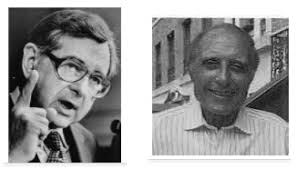
Bernard Nathanson and Larry Lader

By Bonnie Finnerty, Education Director

The investigative research, the historical perspective, the eloquent writing…there is a lot to admire in Sue Ellen Browder’s book Subverted: How I Helped the Sexual Revolution Hijack the Women’s Movement.  But perhaps most powerful is her own journey as mom and young professional that parallels and echoes the women’s movement. She wasn’t just an observer of a cultural phenomenon, she was immersed in it.

In Chapter 3, Making Up a Revolution, Browder recalls looking for journalism work and being forced to conceal having a child in order to get a job. Motherhood was frowned upon as it limited a woman’s freedom to devote herself completely to other endeavors.  The irony of this “woke feminism” is that women were only trading one prejudice for another. As Browder says, “Freedom for women was in the air. But mothers were still in chains.”

Promoting this untethered working woman identity was Browder’s boss, Cosmopolitan’s editor-in-chief, Helen Gurley Brown. She believed what held women back from career success was the “built-in mechanism in their bodies that allows them to have babies.” In other words, she viewed a woman’s natural gift of fertility as her single biggest detriment.

Through her magazine and specifically the fictional Cosmo Girl, Helen Gurley Brown advanced the propaganda of the sexual revolution, endorsing unmarried sex free from motherhood. Hence contraception, and hence, abortion as “backup.”

To make her articles palatable to Brown, Browder invented story lines to suit that agenda, describing herself as “a mercenary, a literary soldier for hire.” Little by little, journalistic ethics were abandoned.  Eventually, Browder felt the disconnect between her professional persona and her life as a loving wife and mother. And it made her sick, physically sick. 

Yet, like many others, Browder was drawn to a movement that fought for greater opportunities. She looked to feminist leaders like Betty Friedan and the newly formed National Organization of Women (NOW) as signposts of hope and “scrambled to climb aboard NOW’s freedom train.” It would be many years before learning the backstory of NOW and realizing that Browder herself was not only a purveyor of propaganda but a victim of it.

 In Chapter 4 The Deceiver Becomes the Deceived Browder introduces us to Lawrence Lader, “a Harvard grad, heir to old money, and close friend to Betty Friedan.” Lader wrote the biography of Margaret Sanger, whom he considered the greatest influence of his life. A secondary influence was Hugh Moore, author of “The Population Bomb” who believed “too many babies were the root cause of poverty, crime, and wars.”  Lader also penned Moore’s biography, warning that “We are on the way to breeding ourselves to death.”

Despite his obsession with abortion “as the royal road to sexual freedom,” Lader’s friend and fellow writer, Betty Friedan, remained unconvinced for many years.  Ultimately, however, she was won over. And we know how from the first-hand testimony of Dr. Bernard Nathanson.

Nathanson directed one of the largest abortion clinics in the world and partnered with Lader to found the National Association for the Repeal of Abortion Laws (NARAL).  On a car trip in 1967, Lader declared his intention of recruiting feminists for his abortion crusade.

He also revealed his plan to identify the common enemy of the “revolution”—the Catholic Church hierarchy. And he shared the slogan that would further abortion propaganda: No woman can call herself free who does not own and control her own body. Lader would credit Sanger with that slogan, but if it were hers, it’s unlikely she meant to promote abortion. Sanger called abortion “barbaric” with the issue dividing her and Lader until her death.

Lader’s carefully crafted 1966 book Abortion finally swayed Friedan to embrace the issue as part of the women’s movement.  However, she would meet with opposition within NOW, a story told in later chapters.

Lader’s book also greatly influenced Justice Harry Blackmum. Abortion, along with bogus history supplied by NARAL attorney Cyril Chestnut Means, Jr., was cited fourteen times in the majority opinions he wrote for Roe and Doe.

Statistics in Lader’s book and in later NARAL press releases were fabricated, an admission later made known by Nathanson, a pro-life convert. “Knowing that if a true poll were taken we would be soundly defeated, we simply fabricated the results of fictional polls,” he confessed.

In addition, Lader and Nathanson also fabricated the number of illegal abortions and the number of women who died from illegal abortions. These lies “took root in the consciousness of Americans” convincing many that “we needed to crack the abortion law.”

But many feminists were not on board with the abortion agenda, as Betty Friedan would soon learn.

Join us in reading Chapters 5 and 6 for next week’s installment.

Quotable quotes:

 “Laced with partial truth, propaganda’s bitter poison become more difficult to detect and sweeter to swallow.” (p. 39)

“The fantasy of a woman as a radical individualist who belongs only to herself and is disconnected from others-betrays the truth of women’s lives.” (p. 44)

A Book Worthy of a Second Look: Subverted, Chapters 1 & 2

By Bonnie Finnerty, Education Director

With so many books, so little time, few books tempt me into a second reading. However, our Winter Lit for Life book recommendation is one of them. The first time I read it, I eagerly gulped down page after page, trying to digest all the revelations.  But Sue Ellen Browder’s Subverted: How I Helped the Sexual Revolution Hijack the Women’s Movement merits a slow, deliberate re-read, one that allows us to ponder the true story of the feminist movement and the forces within and around it. One that challenges the prevailing cultural narrative.

For that reason, we are reading two chapters a week and posting a blog that will include intriguing quotations. We invite you to read along with us and to share your reactions on social media.

In the opening chapter to the book entitled The Inside Witness, Browder introduces herself as the small-town girl looking for big city action after graduating with a journalism degree. She “succeeds” when she lands a job at Cosmopolitan in 1970 as a freelance writer, securing a front row seat to New York City’s cultural revolution for 24 years.

That transformation included two movements that Browder says were not originally united. “In the beginning, the women’s movement and the sexual revolution were distinctly separate cultural phenomena.”

Browder confesses that much of what she and others at Cosmopolitan wrote was fabricated, calling herself “one of the propagandists who helped sell single women on the notion that sex outside of marriage would set them free.”

And she reveals that the 1960’s women’s movement was hijacked largely due to the efforts of one man devoted to making abortion legal.  Larry Lader, considered a “hidden persuader,” will figure prominently in future chapters.

The title of the second chapter The Problem that Had No Name comes from the “mother of the women’s movement,” Betty Friedan. In her revolutionary 1963 publication The Feminine Mystique, Friedan speculated on the deep dissatisfaction of the American housewife who had been limited by “the deeply engrained cultural belief that the only path to feminine fulfillment was to be a wife and mother.”

While Friedan is considered a trailblazer for women’s rights, Browder points out what has been lost in the feminist narrative—that Friedan was not anti-marriage or anti-family. She disliked the phrase “women’s liberation,” preferring to characterize the women’s movement as a fight for equality.  

Browder and Betty Friedan had a shared experience–both were fired for being pregnant, a not uncommon practice back then, unfortunately. Even so, Browder points out that the first edition of The Feminine Mystique never mentioned abortion or the Pill.

Rather than change women and their child-bearing ability, Friedan aimed to change society, “to take the actions needed to bring women into the mainstream of American society, now, fully equality for women, in fully equal partnership with men.”  That, says Browder, was the “original rallying cry” of the modern women’s movement.

So how did the women’s movement, an admittedly noble cause for social justice aimed at equal education and employment opportunities, become so enmeshed with abortion?

Stay tuned as we read Chapters 3 and 4 for this Friday.

Quotable quotes:

Chapter 1: “Propaganda-withheld truths-cuts off democratic discourse, blocks genuine dialogue, and keeps the public from participating in reality.”

Chapter 2: “Women are the people who give birth to children, and that is a necessary value in society…Feminism was not opposed to marriage and motherhood…You want a feminism that includes women who have children and want children because that’s the majority of women.” -Betty Friedan